
You’ll receive the guide instantly and a copy will be sent to your email.
Land value depends on what can realistically be built, what buyers will pay for the finished product, and what it will cost to get there.
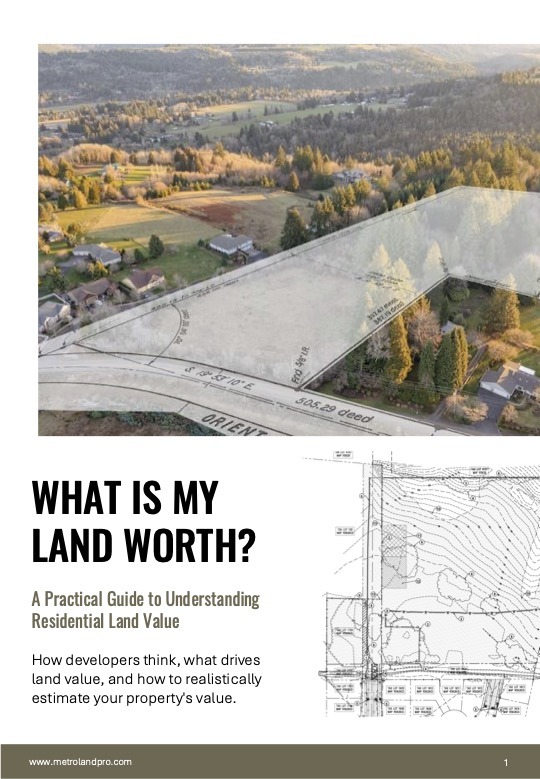
This page introduces the main factors that affect residential development land value. For a more detailed explanation, examples, and practical research steps, download the Landowner Value Guide.
Understand how developers price land, why similar properties can have very different values, and how to start evaluating your own property.
Enter your name and email to receive the guide instantly. A copy will also be sent to your email.
When developers evaluate residential land, they usually start with the finished project: what they could build and what those homes or units could sell for.
From that projected revenue, they subtract construction costs, infrastructure and site improvements, other project expenses, and their required profit. What remains helps determine what they can afford to pay for the land.
This approach is called residual land valuation. It explains why acreage alone tells you relatively little about development value. A larger property may support fewer homes or require more expensive improvements than a smaller property nearby.
The numbers also depend on assumptions. As buyers investigate the property and work through requirements with the city and utility providers, their understanding of costs and development potential can change.
Zoning establishes the uses and density that may be allowed. But the number of homes permitted on paper may differ from what the site can actually support. Market demand also matters: additional density only adds value when the resulting project makes financial sense.
Utility availability can affect both development cost and timing. A nearby sewer line does not necessarily mean there is capacity to serve a new project. Expensive extensions or system improvements can reduce what a buyer can pay for the land.
A property needs access that meets the requirements of its proposed development. Road improvements, steep slopes, retaining walls, and difficult soil conditions can add substantial costs or limit the usable area.
Wetlands, floodplains, protected areas, and required buffers can affect where development is possible. Their impact depends on how much of the property is affected and how those restrictions interact with the proposed project.
Some properties require annexation, a zone change, or other approvals before development can proceed. Buyers consider the time, expense, and uncertainty involved when deciding what to offer.
Together, these factors explain why two properties with similar acreage and zoning can have very different values.
Comparable land sales provide a useful starting point, but the properties need to be comparable in more than size and location.
Look at zoning, access, utilities, slope, environmental constraints, and approval status. A sale involving approved development land may tell you little about a property that still needs significant infrastructure and approvals.
Start by confirming your zoning, reviewing city or county property maps, and asking planning staff and utility providers about known constraints. Use what you learn to develop a preliminary value range and identify the questions that need further investigation.
The full guide walks through these steps in more detail, including how to evaluate comparable sales and what questions to ask.
If you’re considering selling or want help understanding your property’s potential, complete the form below.
I’ll take an initial look at your property and follow up with next steps based on its location, characteristics, and your goals.